The Challenge Ahead
Perception and robotics have impressively progressed in recent years, yet one of the most fundamental tasks — grasping and manipulating objects — remains challenging in real-world settings. The 11th Robotic Grasping and Manipulation Competition (RGMC) brings together researchers, engineers, and innovators to tackle this problem head-on.
Held during the 2026 IEEE/RAS International Conference on Robotics and Automation (ICRA) in Vienna, RGMC provides a unique event to benchmark your work against other state-of-the-art solutions and advance robotic grasping and manipulation in practical, unconstrained environments.
RGMC isn't just a competition — it's a community-driven initiative to solve real problems in robotic grasping and manipulation. Whether you're an academic lab, industry team, or student group, you'll gain access to cutting-edge hardware, publish peer-reviewed research, and compete for recognition and cash prizes.
What is RGMC?
The Robotic Grasping and Manipulation Competition is an annual event that represents a unique approach to advancing the field and challenges teams to develop robust solutions for grasping and manipulating objects in real-world conditions rather than relying on simulation or isolated lab benchmarks. Now in its 11th edition, RGMC has been running since 2016 at either ICRA or IROS, engaging the community with diverse tasks for manufacturing, service robotics, and logistics. Previous editions have featured challenges including assembling and disassembling boards, hand-in-hand grasping, picking and placing various objects, pouring liquids, bin picking, table arrangement, and cloth folding. Each task is designed to expose the gap between controlled environments and practical deployment. Variable illumination, occlusions, object variability, and unpredictable physical interactions are not obstacles to overcome; they are the core of the challenge.
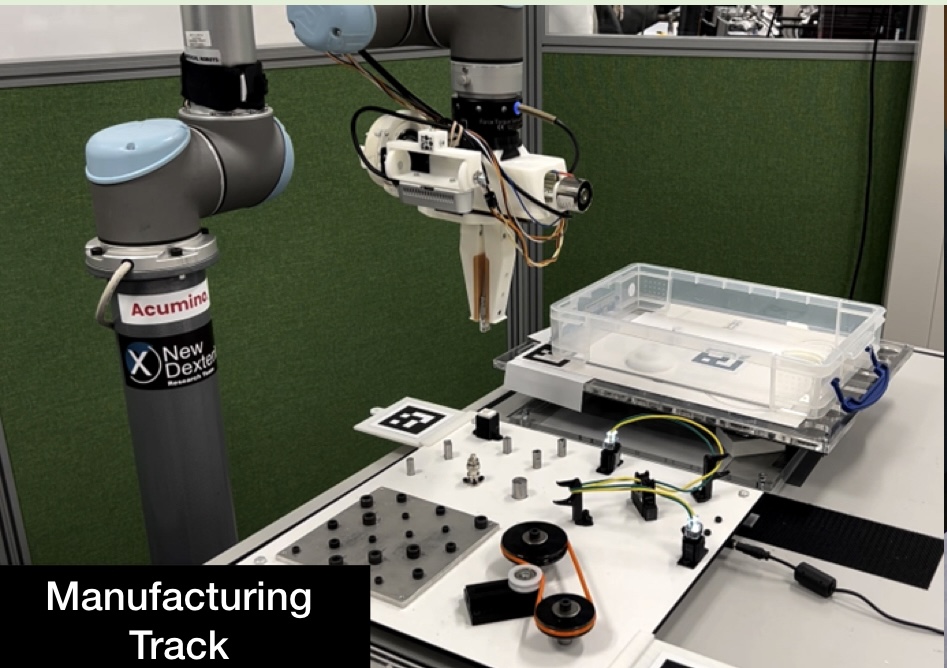
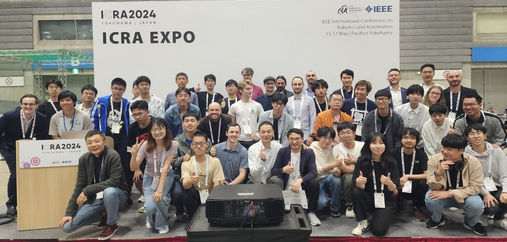
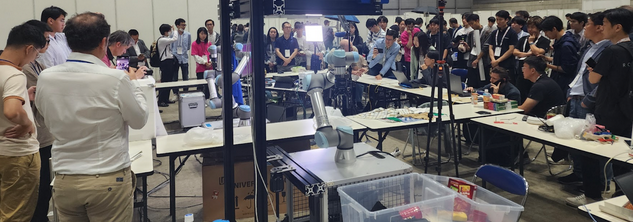
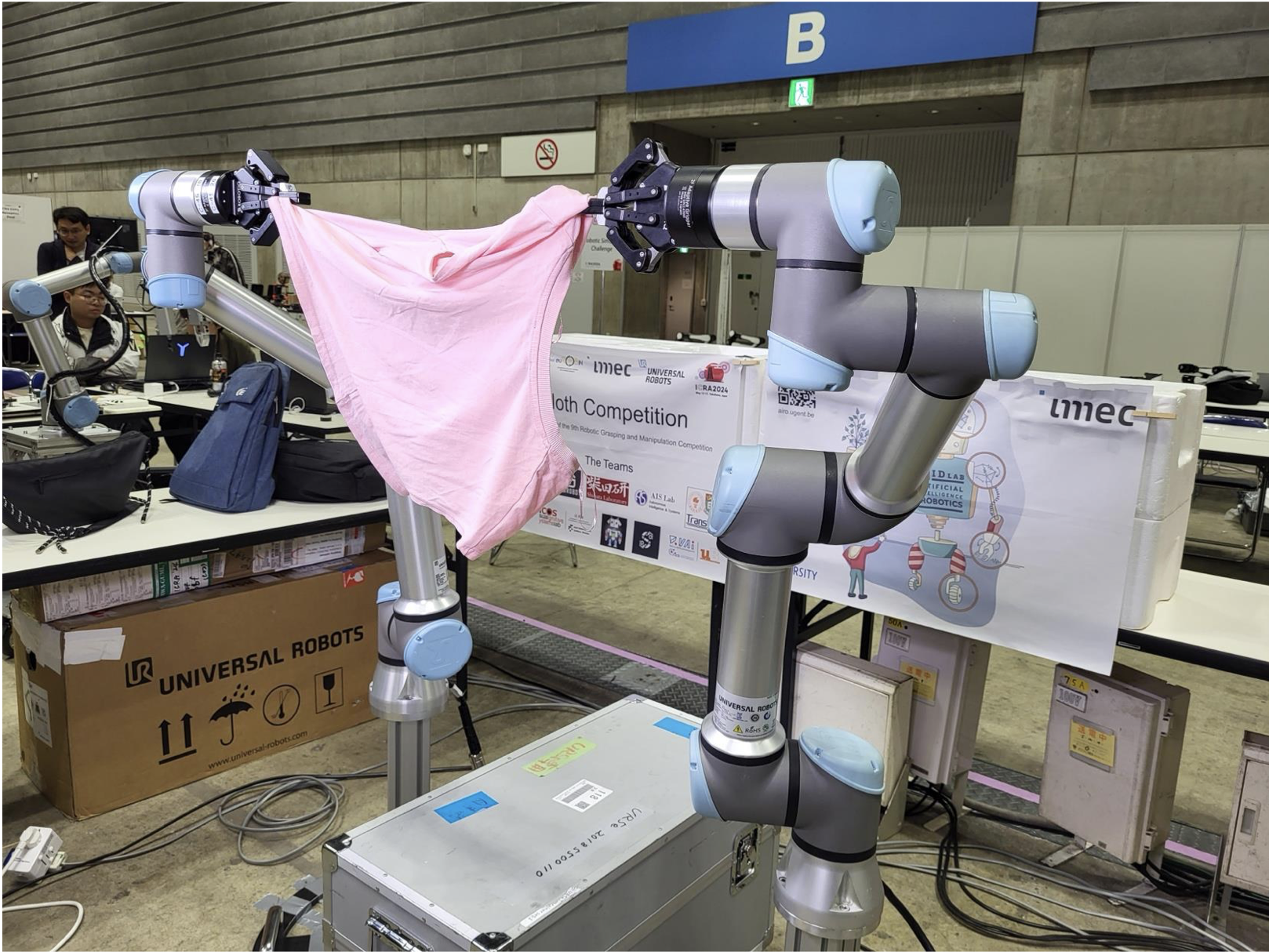
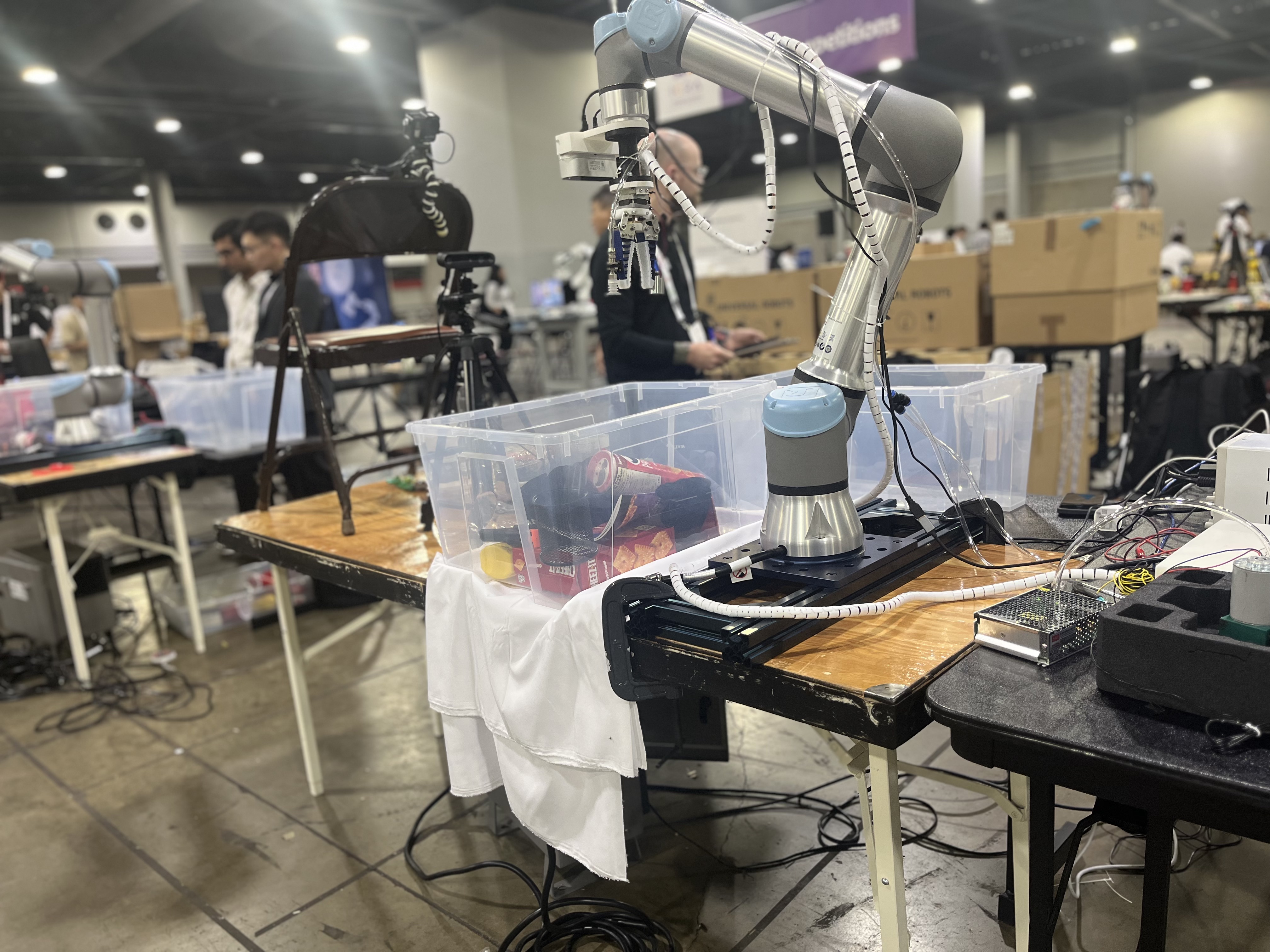
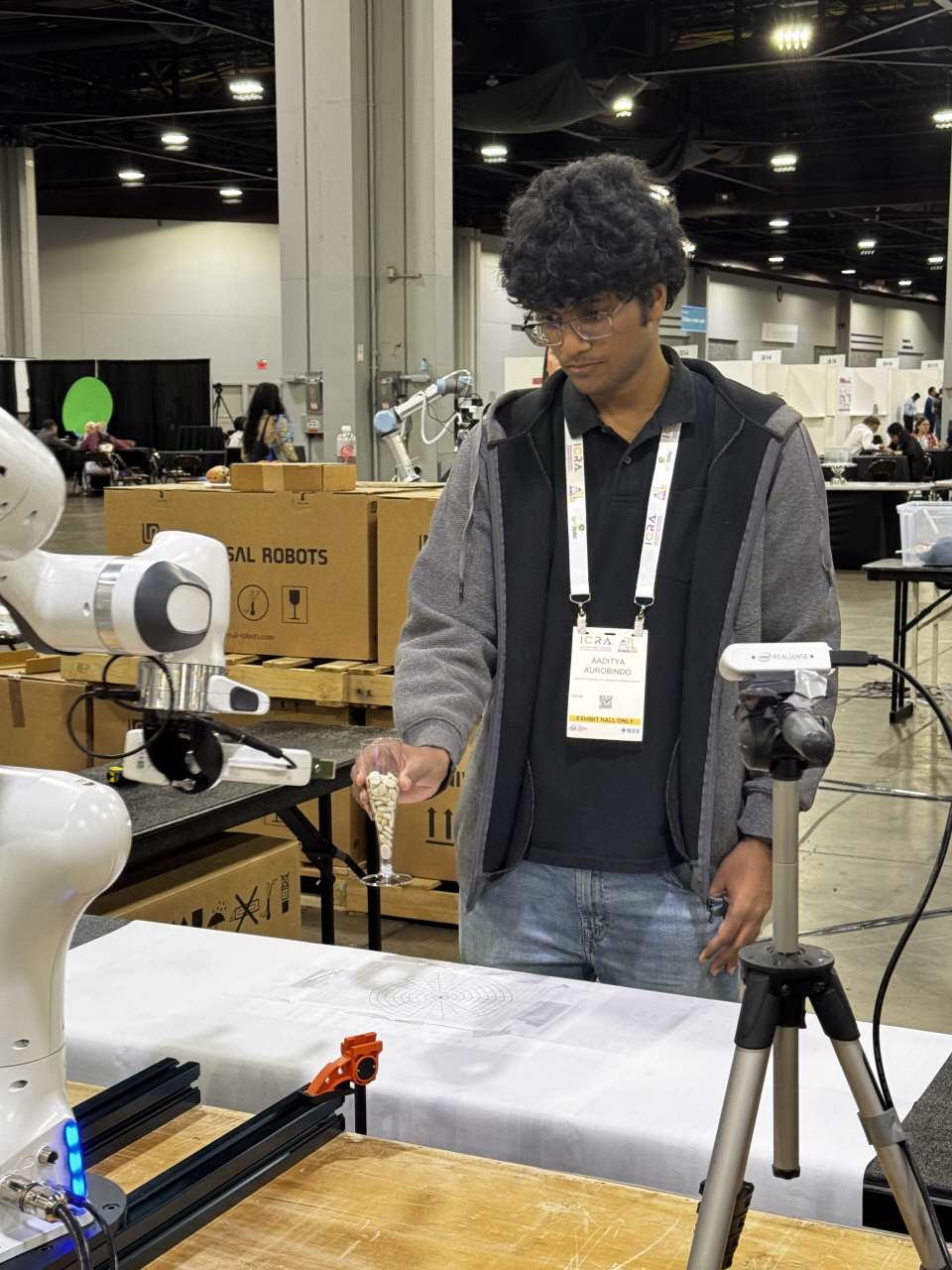
The impact of RGMC extends far beyond competition results, growning into a thriving community of researchers and practitioners advancing robotic grasping and manipulation The research community has embraced the competition as a reference point for rigorous benchmarking: recent findings have been published in IEEE Robotics & Automation Magazine, dedicated IROS workshops have established best practices for competition design and evaluation, and an active YouTube channel, featuring 23+ demo videos from competing teams, is maintained to provide valuable documentation of diverse solution strategies. With ten completed editions across ICRA and IROS, RGMC is a relevant venue for validating robotic solutions in practical, reproducible settings.
The 2026 edition features four specialized tracks covering different aspects of robotic manipulation:
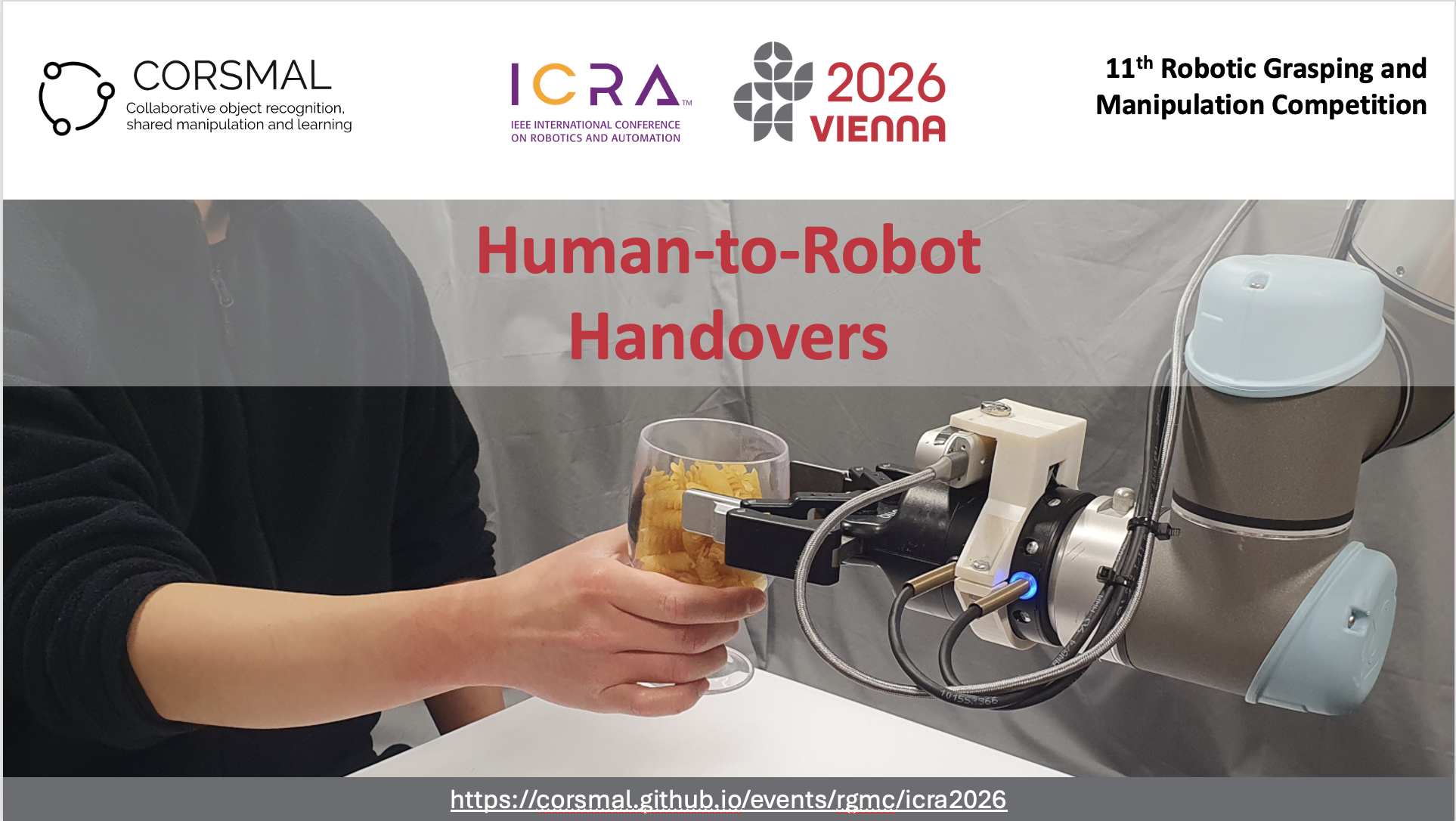
- Human-to-Robot Handover (3rd edition) – Robots that estimate object properties and safely receive items handed by humans, then deliver them to target locations
- Picking from Clutter (3rd edition) – Robots that picks a mix of known and unknown objects randomly placed inside a transparent box (cluttered environment), and places them into another box within a specified time limit and with a predefined grasping order.
- Mobile Manipulation (1st edition) – Robots that autonomously navigate between multiple workstations, perform precise docking, and execute an industrially inspired assembly task based on the NIST Assembly Task Boards (in collaboration with PAL Robotics)
- Cloud Robotics (1st edition) – Remote manipulation using CloudGripper platform at KTH Royal Institute of Technology, including planar pushing and deformable object control
The Human-to-Robot Handover Track
This year, we're spotlighting the Human-to-Robot Handover track—now in its 3rd edition — which addresses one of the most critical challenges in collaborative robotics: enabling safe, reliable transfer of objects from human hands to robotic grippers. Building on the success of previous editions at ICRA 2024 and ICRA 2025, this track continues to push the boundaries of real-world human-robot collaboration.
🫱🥤🤖 Real-Time Physical Property Estimation
The core challenge: Can your robot safely and smoohtly receive - in real-time - a set of unknown containers with unknown filling handed over by a person and deliver them to a target location without dropping them?
Teams must design solutions that enable robots to infer the physical properties (mass, stiffness, fill level) of objects during dynamic handovers, using only affordable perception. This is harder than it sounds. Consider the real-world complexities:
- Unknown objects: Food containers and drinking glasses of varying shapes and sizes
- Unknown content: Containers may be empty or filled with unknown substances at unknown levels
- Unknown physics: The robot must estimate physical properties on-the-fly, with no prior knowledge
- Perceptual challenges: Illumination variations, reflections, transparencies, and occlusions from both the human and robot
- Hardware constraints: No motion capture systems or markers— only affordable sensors (cameras, microphones and tactile sensors)
Why This Matters
Human-to-Robot Object Handover is fundamental to collaborative robotics. From manufacturing to assistive robotics to household automation, robots that can safely receive objects from humans open entirely new possibilities. However, the task demands simultaneous excellence in perception, control, safety, and generalization. By solving handover, we're pushing robotics closer to real-world deployment in diverse environments.
What Participants Gain
Beyond the thrill and the chance of winning the competition tracks, RGMC offers to the participating teams to receive:
Test your algorithms on UR5 and Franka Emika Panda robots at the competition site (based on availability)
Benchmark against state-of-the-art solutions and contribute to advancing the field in real conditions
Contribute peer-reviewed research articles to the Topical Collection in Autonomous Robots
Showcase your demo video on the RGMC YouTube channel, reaching the research community worldwide
Secure a free MATLAB license to support your solution development
Win cash prizes for top-performing teams and earn recognition at ICRA 2026
Key Dates & Application Process
How to Apply: Fill out the registration form at: RGMC Registration Form
Note: Applications after the deadline may be considered based on available spots and solution readiness. With 30+ teams already applied across all four tracks, early submission is recommended.
Get Started
Ready to join? Here are your next steps:
- Visit the official RGMC website: https://sites.google.com/view/rgmcomp
- Explore detailed track information: https://corsmal.github.io/events/rgmc/icra2026/
- Submit your application by 23 February 2026
- Prepare your solution to be ready for the competition and qualify for the on-site participation
- Showcase your work and compete at ICRA 2026 in Vienna
Ready to Advance Robotic Grasping and Manipulation?
Join 30+ teams competing at the cutting edge of real-world robotics.
The Human-to-Robot Handover track awaits your innovation.
A Challenging but Essential Task
The Human-to-Robot Handover track tackles one of robotics' hardest problems: reliable real-world performance while collaborating with a person. This is why participation has been modest—only teams with mature solutions and significant resources can realistically compete.
The track's first year (ICRA 2024) revealed the gap between lab conditions and conference reality. Nine teams registered worldwide; three competed on-site. Teams faced immediate challenges: unfamiliar hardware with minimal setup time, real-world lighting variations, and the need for rapid system calibration. Most teams struggled to complete even a fraction of the 24 handover configurations. The best performance achieved just 18/100, a reminder that real-world manipulation is fundamentally different from lab controlled conditions.
The trajectory from 2024 to 2025 tells us a story of progress. The ICRA 2024 winning team returned in Atlanta and not only won again, but dramatically improved their score to 70/100. This represents a 4x improvement and demonstrates that the benchmark successfully drives innovation. Yet the score also shows substantial room for advancement, making the track ideal for researchers ready to push the boundaries of what's possible. It's an excellent benchmark for the next generation of solutions.
For ICRA 2026, we're seeing growing momentum. Eleven teams have already applied to the handover track, with more expected before the deadline. We anticipate a maximum of 6 teams will qualify for on-site participation, your chance to test your solution against the other teams and the real-world conditions of the competition. Whether you're developing new perception algorithms, adaptive control strategies, or innovative sensor fusion approaches, the handover track will push your work to its limits and provide the validation only live competition can offer.
Track Organizers: Changjae Oh, Andrea Cavallaro, Alessio Xompero
RGMC 2026 Organizers: Berk Calli, Yu Sun, Salvatore D'Avella, Kaiyu Hang, Florian T. Pokorny, Kenny Kimble, Omar Aboul-Enein, Narcís Miguel i Baños, Yasemin Bekiroglu
Sponsors: PAL Robotics, Universal Robots, Franka Robotics, MathWorks, ASTM International, item - industrial applications, Macnica Americas, IEEE RAS TC on Grasping and Manipulation